Join More Than 50,000+ Subscribers and get latest camera news and rumors
NEW CAMERA VIDEOS ON YOUTUBE
|
By admin, on September 1st, 2026
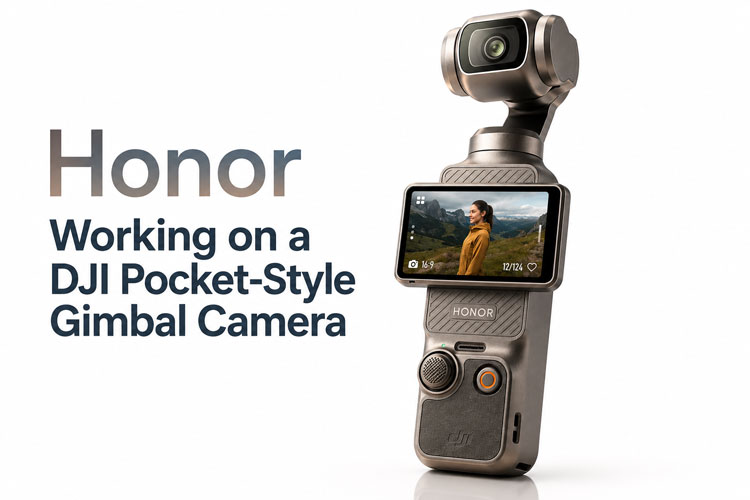
Finally, the pocket gimbal camera is here, and many users are getting it since it has a completely different appeal, while those who were planning to buy a gimbal camera have been waiting. They were confused. Should they buy it or not? Now they are willing to buy the entire package since this smartphone already has a pocket gimbal built-in.
Honour already sells a smartphone with a real moving camera arm. Ten days later, a top Chinese leaker said Honor also wants a standalone handheld gimbal camera – the shape that made DJI Osmo Pocket a default vlog tool. One of those products is shipping. The other is still a secret. Do not mix them up.
That couple poster is teaser art. Caption: 荣耀云台相机. Portuguese line: “Psst… temos um segredo para te contar.” Translation: we have a secret to tell you. The hardware in the frame is a handle + tilting head + red record button. That is Pocket language. That is not Robot Phone.
The market is on fire.
Obviously, after the DJI Pocket gimbal series, vlogging cameras have created a new consumer base and become one of the most popular content creation tools of all time. Now every company wants to try their hands on the Pocket gimbal camera series. Recently, Insta360 has introduced 2 brand-new Pocket gimbal cameras, which include the Luna Ultra as well as the Luna Pro. Other than that, OPPO and vivo are building vlog cameras. Honor just walked into that war with a phone. The leak says it may walk in again with a camera.

The poster is lying if you read it too fast
荣耀云台相机 means “Honor gimbal camera.” That phrase covers two products. Only one exists.
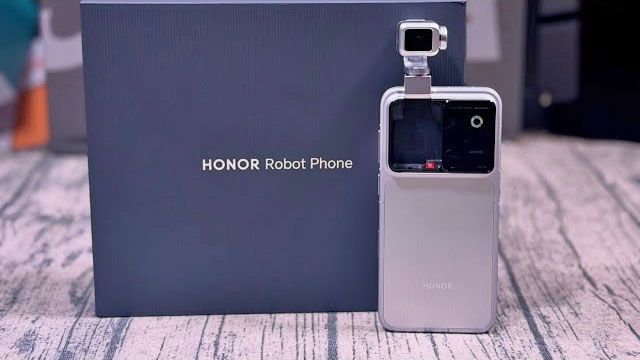
Robot Phone is a 6.3-inch slab. The camera lives in the rear island. It unfolds, tracks, then folds shut.
The poster shows a silver vertical handle, a small front screen, a red rec key, a camera head that tilts like Osmo Pocket. If you publish that image as Robot Phone, you are wrong. If you publish it as a confirmed Honor Pocket, you are also wrong. It is a rumor visual. Treat it as smoke, not a spec sheet.
Why this category is no longer a toy
It looks like the sale of Honor Robot Phone has completely changed the perspective of Honor towards their future product-line strategy, and due to the massive popularity and sales, they have decided to finally enter DJI’s territory by introducing a standalone Pocket gimbal camera with one of the most advanced feature sets for content creators possible.
What Honor would have to beat or lose on day one – Bottom line
Honor is already a gimbal-camera company. Robot Phone is not a concept. It ships. The arm moves. The price is brutal. The color science is the flex.
The next question is colder: will Honor also sell a jacket-pocket camera so you do not have to carry a 248 g phone to get that arm? Digital Chat Station said yes. The poster whispered “secret.” Honor has said nothing.
Until there is a name, a spec table, and a date — Robot Phone is news. The standalone camera is a rumor.
Quoted: the IT Home Chinese sentence and the poster’s Portuguese line. Everything else is condensed from Honor and launch coverage. Standalone specs: unconfirmed as of 1 September 2026.
The article “Honor Working on a DJI Pocket-Style Gimbal Camera” was written by thenewcamera.com team on 5:06 pm, Tuesday, 1 September 2026, Greenwich Mean Time (GMT) | You can also follow us on Our Official Social Media Handles FACEBOOK | TWITTER | INSTAGRAM to get live news — > get live get live Camera News + Insta360 Drone Rumors 24X7
By admin, on August 31st, 2026
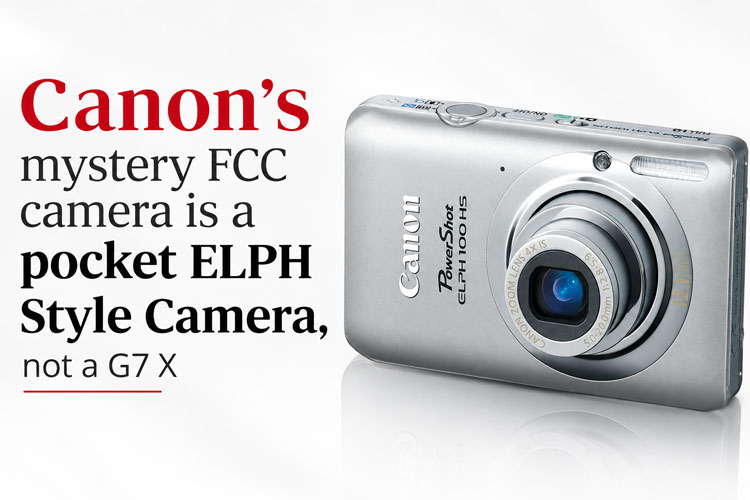
We are talking about the camera that is registered with the FCC and about to arrive, and its Confimred tha the Announcement of the camera will happen before January 2027. (The FCC is 18 January 2027, 180 days confidently period ends that day, and the announcement has to be made before 18th January)
Before we jump to details, it’s one of the 5 cameras that have been recently registered by Canon; you can see a detailed list of cameras here
(Based on the facts we are getting from the FCC document)
The short answer
Now, based on the set of features we are getting inside the camera and the size we can clearly estimate which category it will fall into
A short, plain-language briefing on factory code DS126991 (FCC ID AZD264): confirmed facts, reasonable inference, expected price, and what is still locked until January 2027.
Everything that is public points to an entry-level PowerShot ELPH / IXUS / IXY-class pocket compact – most likely a USB-C refresh of the current cheap ELPH line – not a premium stills compact and not a vlogging gimbal.
Announcement is expected no later than 18 January 2027, which is also the date Canon’s external photos and user manual come off short-term FCC confidentiality.
Fact versus inference
| Status |
What it means |
| Confirmed |
Canon digital camera. Factory model DS126991. FCC ID AZD264. 2.4 GHz Wi-Fi only (2412–2462 MHz). Pocket-size body about 88 × 55 mm. Filing dated 23 July 2026. Photos/manual locked until 18 Jan 2027. |
| Strong inference |
Inexpensive PowerShot / ELPH / IXUS class. No Bluetooth. Wi-Fi + NFC pairing like current ELPH 360 HS A. USB-C likely. Announcement by mid-January 2027. |
| Not known |
Retail name, sensor size, zoom range, 4K or not, battery, India launch, exact price. |
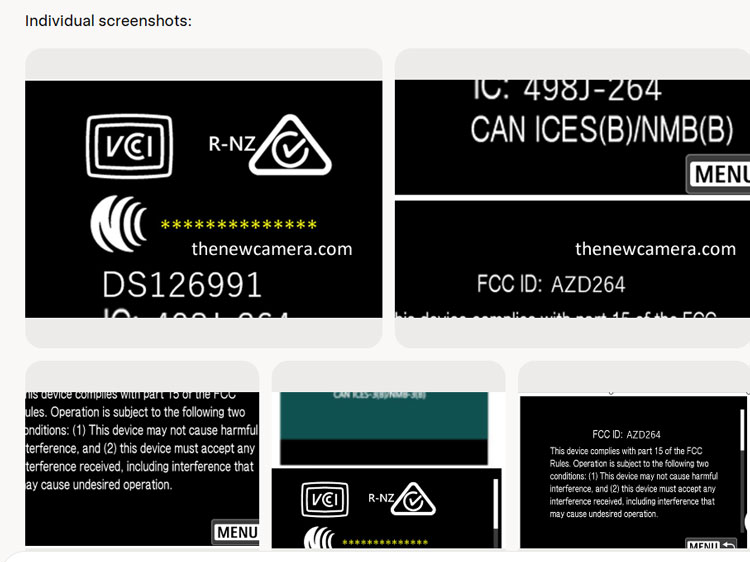
What we know from the FCC file
The public exhibit is not a product brochure. It is a radio certification. Still, it is enough to identify the camera.
- Maker: Canon Inc. Equipment class: digital camera.
- Internal model printed on the e-label screen: DS126991.
- Radio: 2.4 GHz Wi-Fi only. Conducted power about 0.13 W. No 5 GHz Wi-Fi and no Bluetooth in this grant.
- On-screen label path: Menu → Authentication Mark. Typical compact-camera UI, not an EOS R body.
- SAR outline is a small rectangle, about 88.2 mm wide by 55.2 mm tall – Similar to ELPH pocket size, not G7 X (105 × 61 mm) and not V1 (118 × 68 mm).
- External photos, internal photos, test-setup photos and the user manual stay confidential until 18 January 2027.
What it is — and what it is not
| Likely |
Not this camera |
| Entry-level PowerShot ELPH / IXUS / IXY pocket compact |
PowerShot G7 X Mark III or a G7 X successor |
| Wi-Fi + NFC, no Bluetooth |
PowerShot V10 or V1 (both have Bluetooth) |
| USB-C refresh of the ELPH 360 HS A / IXUS 285 HS A idea |
Insta360 Luna Ultra or DJI Osmo Pocket 4P |
| Point-and-shoot for travel, family, everyday snapshots |
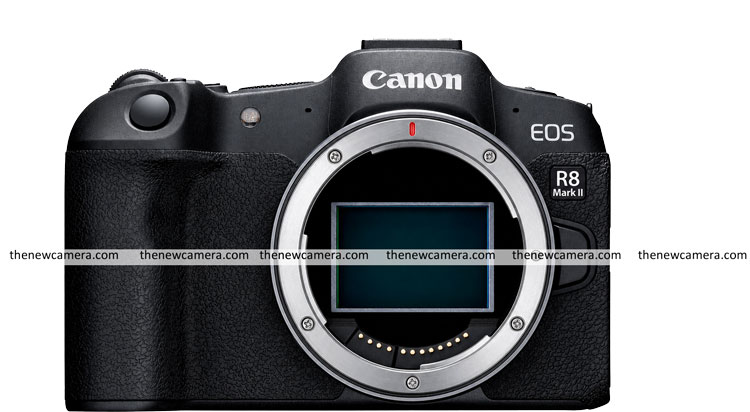
EOS R8 II or any interchangeable-lens body (those use other DS codes and 5 GHz + Bluetooth) |
Canon’s current cheap compact, the ELPH 360 HS A (IXUS 285 HS A outside the US), already uses Wi-Fi + NFC and no Bluetooth. Rumor sites tracking DS126991 describe the same radio: inexpensive PCB antenna, 2.4 GHz only, NFC instead of Bluetooth. That is the family this filing belongs to.
What the size actually matches
The SAR report draws the camera as a rectangle about 88.2 mm wide by 55.2 mm tall. That is not a CIPA spec. It is the face of the body as tested for radio exposure. Real shop measurements can be a few millimetres larger once you add the lens ring, buttons and CIPA rounding. Even so, the outline is useful: it is pocket-ELPH size, not G-series size.
| Camera |
Official size (W × H × D) |
Versus ~88 × 55 |
| AZD264 / DS126991 |
~88 × 55 mm (SAR face) |
This camera |
| ELPH 360 HS A / IXUS 285 HS A |
99.6 × 58.0 × 22.8 mm |
Wider; current cheap ELPH |
| ELPH 180 / IXUS 175 |
95.2 × 54.3 × 22.1 mm |
Same height class |
| ELPH 300 HS / IXUS 220 HS |
92.2 × 55.9 × 19.5 mm |
Height almost exact |
| ELPH 520 HS / IXUS 500 HS |
87.1 × 53.9 × 19.2 mm |
Width almost exact |
| Early Digital IXUS / ELPH S100 |
87 × 57 × 27 mm |
Same pocket class |
| G7 X Mark III |
105 × 61 × 41 mm |
Clearly bigger and thicker |
| PowerShot V1 |
118 × 68 × 53 mm |
Much bigger |
| PowerShot V10 |
63 × 90 × 34 mm |
Tall vlog shape — not this |
Read the size this way: credit-card-ish pocket compact. Height around 55 mm is the usual ELPH jeans-pocket height. The outline is smaller than today’s ELPH 360 HS A (about 100 mm wide), so either the new body is a bit slimmer or the SAR drawing is the chassis without the full CIPA envelope. Closest living relatives by footprint are older slim ELPHs and the small IXUS 500 HS, not G7 X or V1.
Why the Wi-Fi looks “weak”
2.4 GHz-only Wi-Fi is normal on this class of Canon. It is not the same radio as a 2026 creator camera.
|
DS126991 |
Luna Ultra |
Pocket 4P |
| Bands |
2.4 GHz only |
2.4 + 5 GHz |
2.4 + 5 GHz |
| Standard |
Wi-Fi 4 class |
Wi-Fi 6 |
Wi-Fi 6 |
| Bluetooth |
No |
Yes |
Yes (LE 5.4) |
| Job |
Send JPEGs to a phone |
Live view + 4K/8K dump |
Live view + 4K dump |
For a few holiday photos to Camera Connect, 2.4 GHz is enough. It is slower, more crowded, and not meant for dumping long video. That is a product-class difference, not a surprise defect.
Expected price
Canon already sells the closest live model, the ELPH 360 HS A, at $379 in the US and about £370 / €360–370 in Europe.
| Scenario |
USD launch |
| Aggressive volume price |
$299–329 |
| Most likely |
$349–379 |
| If they hold a “compact revival” premium |
$399 |
Parallel-import pricing in India can stay much higher even if the official number is lower. G7 X / V1 money ($650–900) and Luna / Pocket 4P money ($600–770) are a different shelf.
This is the short update we have related to the camera.
The article “Canon’s mystery compact is not a G7 X, V1, or creator gimbal. Here is what the FCC file really shows.” was written by thenewcamera.com team on 4:56 pm, Monday, 31 August 2026, Greenwich Mean Time (GMT) | You can also follow us on Our Official Social Media Handles FACEBOOK | TWITTER | INSTAGRAM > — more live Camera News + Canon Rumors 24X7
By admin, on August 30th, 2026
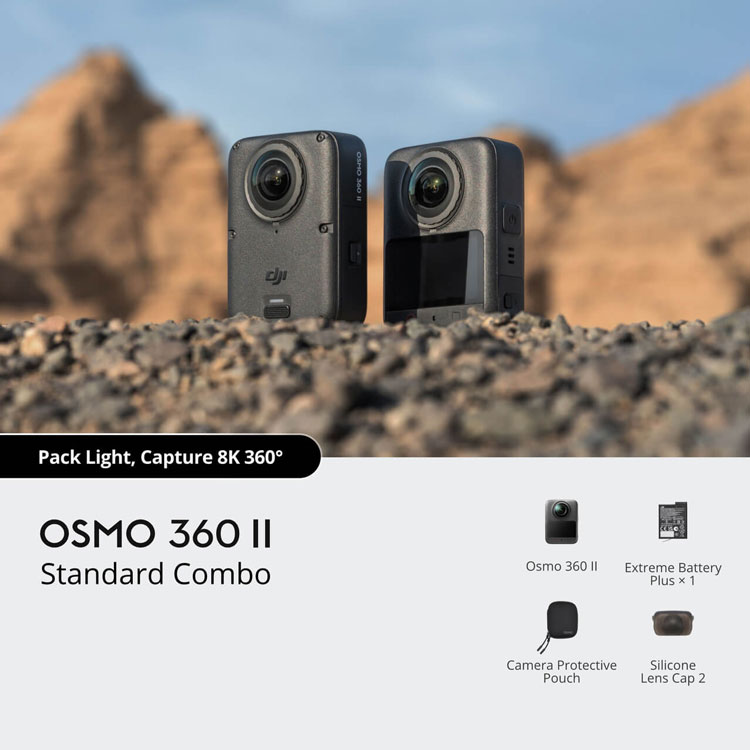
 Image of DJI International page – to be uploaded on Sep 3 For 360 content creators in the United States of America, that’s the biggest question right now. Will the DJI Osmo 360 Mark II become available in the United States of America? Yes, we have seen the camera listed on US online retail websites, which has been described below in the latter part of the article, but wait, you should not take quick action to buy it. We never encourage you to buy an early listing that generally appears randomly. The best thing is that you should wait, and we are going to confirm in our post that the camera has arrived with its proper pricing, but before that, the camera is real, and the sale has already started in China, starting from August 13, 2026. In Japan, it has been stated that the camera will be available from September 2, 2026, and DJI’s own teaser has been locked to September 3, 2026, 7 AM Eastern Standard Time, which gives us very clear information that after the first week of September, the camera will become widely available across the globe.
If you are sitting in the United States right now, this is the only question that matters: can you actually check out an Osmo 360 II on a US website, and if not, should you just buy the Insta360 X6?
The camera is real. China has been selling it since 13 August 2026. Japan is dated 2 September. DJI’s own teaser is locked to 3 September 2026, 7:00 AM Eastern. What is still missing is an official US dollar price and a DJI Store US product page. Amazon has a listing. It is not DJI’s price.
That empty American page is not the same story as Pocket 4 / Pocket 4P. Those cameras never got an FCC grant. This one did.
OSMO 360 II US Status Tonight — One Table
| Question |
Answer as of 30 August 2026 |
| B&H / Adorama official listing |
Soon to Become Available |
| FCC authorization |
Yes — FCC ID 2ANDR-OQ0022512, granted 21 Dec 2025 |
| Legal to import / sell a previously authorized model? |
Covered List blocks new grants, not this one |
| Will DJI put it on store.dji.com/us on 3 Sep? |
Unknown. That is the whole article |
| What US buyers can order today |
Insta360 X6 at $699.99, first-gen Osmo 360 used / leftover stock |
DJI OSMO 360 II FCC Granted Before DJI 2025 Ban- Why This Camera Is Different From Pocket 4
A lot of US readers are mixing two DJI problems into one sentence. Separate them.
Problem A — Covered List (22 December 2025)
The FCC put DJI on the Covered List. After that date, new equipment authorizations for DJI radios are frozen. That is why Osmo Pocket 4, Pocket 4P, Osmo Mobile 8P, Lito, and Mic Mini 2S never got a normal US launch.
Problem B — this specific camera
The Osmo 360 II grant is dated 21 December 2025. That is one day before the cutoff. FCC ID 2ANDR-OQ0022512, filed to SZ DJI Osmo Technology Co., Ltd. Previously authorized models can still be imported and sold. DJI is allowed to sell this camera in America. They have simply not listed it.
So if 3 September comes and goes with no US SKU, that is a business decision, not an FCC lock. Same pattern as the first Osmo 360 in July 2025: DJI skipped its own US store, and B&H / Adorama / later Amazon filled the gap at $549.99 Standard / $699.99 Adventure.
Watch those three retailers on Wednesday morning, not only store.dji.com.
Yes, the DJI OSMO 360 II is listed at AMAZON.COM for USA buyers, but wait this is not the real price you have to pay.
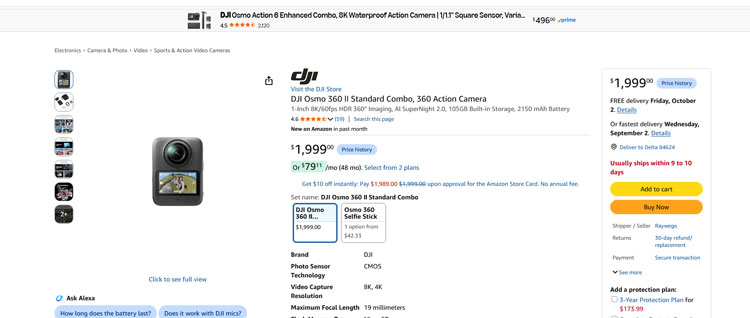
DJI OSMO 360 II listed on Amazon.com
That $1,999 Amazon listing is not the US price
Amazon US is indexing a page titled DJI Osmo 360 II Standard Combo. The spec line is real II language: 8K/60, AI SuperNight 2.0, 105GB, 2150mAh. So this is not a mislabeled gen-1 body.
|
Amazon listing tonight |
What the camera actually sells for |
| Price |
$1,999.00 |
China Standard Combo ¥3,299 (~$460) |
| Sold by |
Raywego (third party) |
DJI / official stores |
| Ships from DJI or Amazon? |
No |
— |
| Delivery |
“Usually 9 to 10 days” / free delivery as late as 2 October |
China is shipping now |
| “Visit the DJI Store” link |
Amazon brand-page chrome |
Does not mean DJI is the seller |
$1,999 is about 4× the China price and about 3.5× what Gen 1 listed for in America ($549.99). If DJI follows the same spread as last year, a real US Standard Combo lands near $499–$549, not two thousand dollars.
This is the same first-print trick we already tracked on thenewcamera.com for the Osmo Pocket 4P.
We flagged the first Amazon US listings on 29 July — third-party stock, not DJI. Opening asks sat near $980 for the Standard Combo and $1,290–$1,390 for the Vlog Combo. By 16 August those same Amazon US pages had dropped to $663.21 Standard and $767.31 Vlog. That drop is on our own pages:
The $980 number was never DJI’s US price. It was the opening gray-market ask, and it did not hold. $1,999 on the Osmo 360 II tonight is that same first print.
Expect the 360 II page to run the same three steps:
- First listing = high ($1,999 tonight).
- More sellers pile on → the number walks down.
- If DJI, Amazon, B&H or Adorama post an official SKU after the 3 Sep, 7 AM Eastern teaser, the $1,999 listing dies overnight.
One extra reason a drop is more likely here than on Pocket 4P: the 360 II already has an FCC grant. Pocket 4P never did, so it could only get cheaper through importers. This camera can get cheaper and get a real US store button.
Do not buy the Raywego listing. Screenshot it, date it, wait. We will update this same page when the number moves. If Wednesday morning still has no official SKU, the cleaner US checkout remains the Insta360 X6 at $699.99.
Expected US Price (Dollars)
DJI has not typed a USD MSRP. The honest way to estimate it is the published Asia prices plus what gen 1 actually sold for in the US.
| Bundle |
China |
Hong Kong |
First-gen US street |
Expected Osmo 360 II US |
Confidence |
| Standard Combo |
¥3,299 (~$460) |
HK$3,899 (~$499) |
$549.99 |
$499 – $549 |
Medium-High |
| Adventure Combo |
¥3,999 (~$560) |
HK$4,699 (~$599) |
$699.99 |
$599 – $649 |
Medium |
| Gray-market / China-ship eBay |
— |
— |
— |
$650 – $800 + no US warranty |
Already visible |
If DJI repeats the gen-1 playbook, Americans will not get the China $460 number. They will get something closer to $549 on a US invoice.
Gray-market Standard Combos are already floating near $685–$699 shipped from China. That is a bad deal. You pay X6 money, lose DJI Care, and still wait on a package. Do not do that this week.
The Date Americans Should Circle
| Date |
What happens |
Why a US buyer cares |
| 2 Sep 2026, 21:00 JST |
DJI Japan on-sale time |
First non-China storefront with a public clock |
| 3 Sep 2026, 7:00 AM EDT |
DJI teaser/event |
4:00 AM Pacific / 7:00 AM New York. This is the US-facing timestamp |
| 3 Sep 2026 |
25% Section 232 tariff on imported drones starts |
Osmo 360 II is a camera, not a drone. Tariff should not hit it the same way Mini 5 Pro does. Still a messy week at customs |
If 7 AM Eastern on 3 September produces a US price, this page gets an update the same hour. If it only produces another international store and another 404 in America, that is also an answer.
Buy the Insta360 X6 today if:
- You need the camera in hand this week
- You want a US retailer, US returns, and a warranty you can call
- 20m waterproofing and the bigger battery matter more than 8K60
Do not buy:
- The Amazon $1,999 Raywego listing — that is a third-party page, not DJI’s US price
- First-gen Osmo 360 at full $549 unless it is heavily discounted — the II fixes the scratched-lens problem
- China-ship eBay “Osmo 360 II Standard Combo” at $680–$800 — that is X6 money with none of the US protections
Do not assume DJI Care / warranty on a gray-market body. Gen 1 already taught that lesson.
Bottom Line for US Buyers
The Osmo 360 II is not banned from America. It cleared the FCC one day before the door shut. DJI has still not given US buyers an official price. The only Amazon button tonight is a $1,999 third-party listing. That is not the number to write about as “US price.”
3 September, 7:00 AM Eastern is the date. Until that hour, the only flagship 360 camera an American can order without drama is the Insta360 X6 at $699.99.
We will update this page the moment B&H, Adorama, Amazon, or store.dji.com/us posts a dollar price.
The article “DJI Osmo 360 II US Release Date, Price & Availability: Can Americans Buy It? (August 30, 2026 Update)” was written by thenewcamera.com team on 7:50 pm, Sunday, 30 August 2026, Greenwich Mean Time (GMT) | You can also follow us on Our Official Social Media Handles FACEBOOK | TWITTER | INSTAGRAM to get live news — > get live get live Camera News + Insta360 Drone Rumors 24X7

By admin, on August 29th, 2026
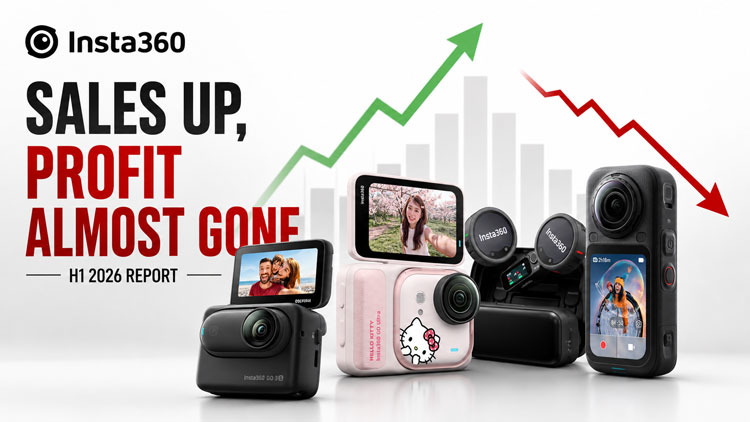
Insta360 is selling a lot of cameras, but they are not able to generate as much profit as they made in the previous year. And believe me, the sales are quite high, which means the numbers are more and higher, but the profit has reached its lowest point, specifically when compared to the previous year’s first-half profit.
Insta360, listed in China as 影石创新 (688775.SH), published its first-half 2026 report on the evening of 27 August. The headline is simple: the company sold a lot more cameras and made almost no money.
That is really a big contrast. We are going to explain this situation in this article in a detailed way, so let’s begin.
than Keep in mind that these profit figures and sales numbers are before the Luna Ultra and Luna Pro announcements. These two announcements hit differently and have become two of the top-selling pocket gimbal cameras in most stores across the United States of America. Since the DJI Pocket 4 Pro has now been banned not only in the USA, but the Asian market is also very keen towards the new Ultra. So, the second-half sales numbers will be quite a bit different than the first half.
1. The numbers check out
The figures circulating after the report match the official filing.
For January–June 2026, Insta360 reported:
- Revenue: RMB 5.517 billion, up 50.29% year on year
- Net profit attributable to shareholders: RMB 30.41 million, down 94.15%
- Profit excluding non-recurring items: a loss of RMB 15.34 million, down 103.12%
- Operating cash flow: an outflow of RMB 2.761 billion, down 1,245.12%
- Weighted average ROE: 0.53%
- Basic and diluted EPS: RMB 0.08, down 94.41%
Exact filing amounts were RMB 5,516,546,762.11 of revenue and RMB 30,407,322.67 of attributable net profit. Media outlets rounded revenue to 55.17亿元. Caixin, IT之家, 证券时报 and MarketScreener all reprinted the same set.
The company is still growing on the top line. Profit and cash generation are not.
2. How much profit did they actually make?
The graph clearly shows the **profit **they made in the first half of 2026, and it is quite disappointing, but we believe profit after the introduction of the new series will be different. But for that, we have to wait until March 2027
2026 is not finished. The only audited window so far is the first six months. In that period, shareholders of the listed company were attributed about RMB 30.4 million. At recent rates that is roughly $4.5 million, or about ₹43 crore.
Put beside sales, that profit is tiny. Revenue was about ₹7,840 crore. The company kept about half a percent of sales as attributable net profit.
Even that ₹43 crore overstates the quality of earnings.
- After stripping one-off items, H1 was a loss of about RMB 15.3 million (~₹22 crore).
- The whole group, including minority partners, lost about RMB 94 million.
- Pre-tax profit was a loss of about RMB 90 million.
The parent company can show a small profit while the group loses money because some new businesses — notably early-stage lines such as panoramic drones — booked large losses that were allocated to minority shareholders.
The year also split in two. Q1 still made about RMB 85 million. Q2 lost about RMB 54 million. Insta360 went from “growing but less profitable” to its first quarterly loss since listing in a single quarter.
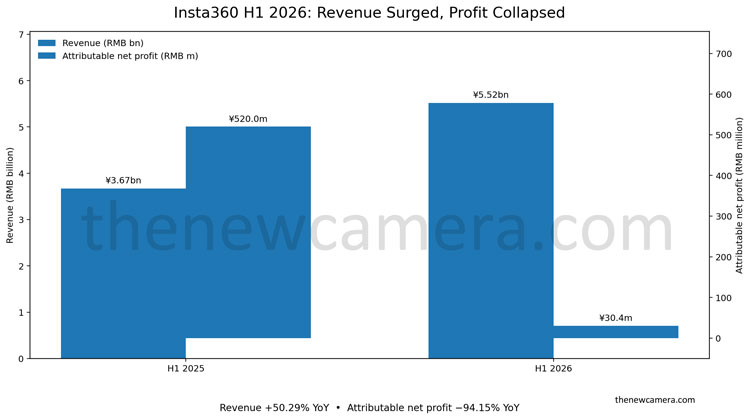
3. Profit did not rise versus last year. It collapsed.
The clean comparison is first half versus first half.
|
H1 2025 |
H1 2026 |
Change |
| Attributable net profit |
RMB 520 million |
RMB 30.4 million |
−RMB 490 million (−94%) |
| Roughly in rupees |
₹739 crore |
₹43 crore |
−₹696 crore |
| Core / 扣非 profit |
profit of RMB 492 million |
loss of RMB 15.3 million |
−103% |
They made about 6% of last year’s first-half profit. Sales were up by half. Profit was down by nineteen-twentieths.
Full-year 2026 profit is still unknown. The 2025 annual profit was much larger — on the order of RMB 929 million — but that is last year’s completed result, not this year’s.
4. Did they just cut prices to buy market share?
Price competition is part of the story. It is not the whole story.
Well, there’s one of the most important parts of this article. According to their own text from the official source of information, Gross margin fell by about 10 percentage points, to roughly 41% from about 51%, which is very low compared to what they should have to generate to make a lot of money. One of the major reasons behind that is the cheap, competitive products available in the market that they have to compete with. Yes, we are talking about DJI, one of the strongest alternatives and a bigger brand than Insta360.
Although DJI is now banned in the USA, and Insta360 has a big relief over that, that’s why we are saying the second half of the results will be quite a bit different. But right now, other than that, Insta360 has also added pocket gimbal series cameras to its portfolio, so it is going to boost the overall sales record of the company.
Other reasons Why Insta 360 Profit is down:
- Memory chips got expensive. Cameras need a lot of storage. Chip prices stayed high. Insta360 also spent nearly RMB 2 billion buying chips ahead of time. That was a supply bet. It also drained cash and hurt near-term profit.
- They spent heavily to build the next product cycle. R&D was about RMB 1.04 billion, almost 19% of sales. New categories, especially panoramic drones, are still in the spend-first stage.
- Mix changed. More new lines and accessories can dilute the old, fatter 360-camera margins.
So the H1 picture is not “they dumped cameras cheap, and that is all.” It is some price and promotion pressure + much higher component costs + a large investment bill. That combination can produce exactly this result: revenue up 50%, profit almost gone, cash flow deeply negative.
5. Why Ultra and Pro make the next chapter different — and why they do not settle it yet
The H1 report is a poor snapshot of the product line Insta360 is selling now.
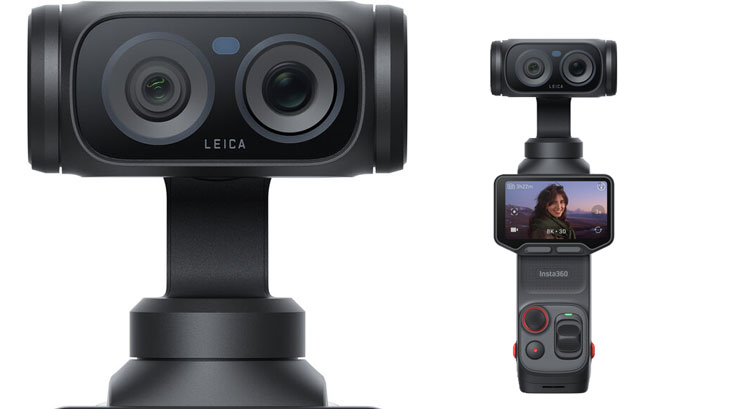
- Luna Ultra, the 8K Leica dual-lens gimbal camera, launched on 10 June 2026. H1 includes only about three weeks of Ultra sales.
- X6, the new flagship 360 camera, launched on 12 August.
- Luna Pro, the 4K vertical gimbal camera, launched on 20 August.
X6 and Pro are not in the H1 accounts at all.
Launch demand for Ultra was real. It sold out in minutes on Chinese platforms. The white version vanished quickly in Japan. There were queues. It reached bestseller lists and later appeared in a Costco bundle in the United States. Insta360 also kept Ultra off the main summer discount event, which is usually a sign that management wants to protect flagship price.
The honest split is this:
- H1 = old mix + a short Ultra burst + expensive chips + heavy investment.
- H2 = Ultra in volume + X6 + Pro, still against the same cost and competition problems.
Insta360’s verified H1 2026 result is not a mystery. It sold about RMB 5.52 billion of product and attributed only RMB 30 million of profit to shareholders. Core operations lost a little money. Cash flowed out by RMB 2.76 billion. Versus the same period last year, profit fell 94%.
That is consistent with a company paying up for chips, spending on R&D and new categories, and fighting DJI for share. It is not proof that the business is broken, and it is not proof that Ultra and Pro have already fixed it.
The next story is narrower: can the new gimbal and 360 lineup turn demand into margin, or will H2 repeat the same pattern — more sales, almost no profit? The H1 report cannot answer that. The October quarter can.
The article “Insta360’s H1 2026: Sales Up, Profit Almost Gone – And Why Ultra/Pro May Change the Next Chapter” was written by thenewcamera.com team on 10:17 am, Saturday, 29 August 2026, Greenwich Mean Time (GMT) | You can also follow us on Our Official Social Media Handles FACEBOOK | TWITTER | INSTAGRAM > get live news — > DJI Rumors | Insta360 News
source here
By admin, on August 28th, 2026

This post actually explores the upcoming Canon cameras’ announcement timeline based on their registration dates and previous announcement patterns by Canon. So, not only the Canon R8 Mark II, which we already know is arriving on September 15, 2026, but we are talking about a set of three more cameras that are about to arrive within the next few months through the first half of 2027. We will be putting down the possible announcement period of all these cameras along with their quotes, so you have a very clear and certified idea of which model is arriving at what timeline.
Information related to the Canon R8 Mark II camera specifications remains very similar at the time I am writing this article. So, the post that we published on August 24 does contain a set of information related to the Canon R8 Mark II camera. If anything significant arises related to the camera, we will be updating it here. But before that, let’s explore the possible arrival dates of Canon’s next generation of cameras.
Have a look at the set of announcement dates of the upcoming cameras. First, we are going to clarify how we are measuring this, based on one of the most recent announcements, the Canon R6 V. Canon maintained roughly a 147-day gap, and this is not news.
Five registered cameras still in the pipeline
Five unreleased Canon bodies have public wireless IDs.
| # |
Registration |
Filed |
Radio type |
Best current read |
Expected announce window |
| 1 |
DS126947 |
15 Apr 2026 |
Dual-band Wi-Fi 4 + Bluetooth |
EOS R8 Mark II |
15 Sep 2026 |
| 2 |
DS126973 |
2 Jun 2026 |
Dual-band Wi-Fi 4 + Bluetooth |
EOS R10 Mark II (APS-C ILC) |
late Oct – early Dec 2026 |
| 3 |
DS126965 |
1 Jul 2026 |
Wi-Fi 5 + Bluetooth |
Higher EOS R body — often guessed as R7 Mark II |
late Nov 2026 – Q1 2027 |
| 4 |
DS126991 |
27 Jul 2026 |
2.4 GHz only, no Bluetooth |
Inexpensive PowerShot / ELPH-class compact |
Dec 2026 – 18 Jan 2027 cap |
| 5 |
DS126986 |
6 Aug 2026 |
Dual-band Wi-Fi 4 + Bluetooth |
Another EOS R / ILC |
early Jan 2027 (4 Jan 2027 cap) |
Rows 2–5 are assignments, not names from Canon. Two clues matter:
- No Bluetooth + 2.4 GHz only on DS126991 is why that ID is being treated as a cheap compact, not a mirrorless body.
- Wi-Fi 5 on DS126965 is why people put a more serious APS-C body (R7 Mark II) there instead of on the June filing.
Canon Rumors has already said the R7 Mark II is not a twin launch with the next R10-class camera, and they have been pointing the R7 Mark II toward Q1 2027 after a long delay. Do not promise three EOS R bodies in September.
What September 2026 actually looks like
Expected announce: 15 September 2026
- EOS R8 Mark II — compact full-frame refresh. Late-August consensus: 24.2MP sensor (not the older 32.5MP rumor), IBIS added, 40fps electronic, single SD card, LP-E17 battery, same size class as the current R8, US body price around $1,800. Product shots are still the missing piece. Do not treat AI renders as official. Full sheet: [your 24 Aug article].
- Speedlite EL-5 Mark II — same-day accessory rumor from 27 August.
- Small bottom grip / plate for the R8 Mark II — extra height for larger hands. Not a battery grip.
- A photography-focused PowerShot has been talked about for September in a separate thread (G7 X-class successor, not the cheap ELPH-style body). That is softer than the R8 Mark II date. Keep it as “possible same month,” not “confirmed 15 September.”
Current EOS R8 body-only stock has already been cut at some US retailers. That is the usual pre-replacement signal. It is not an official discontinuation notice.
Before 15 September we should see product images and a tighter spec list. That is still the next leak, not another date change.
Expected arrival, not just announce day
Announce date ≠ shop date. After the R6 V reveal on 13 May, Canon quoted late June availability — roughly 6 weeks. A mid-September announce usually means cameras in shops in late October to November, in time for the holiday window. That is pattern, not a leak.
Use this as a working calendar:
| Product |
Announce (rumored) |
First stock (pattern) |
| EOS R8 Mark II |
15 Sep 2026 |
late Oct – Nov 2026 |
| EL-5 Mark II + R8 grip |
15 Sep 2026 |
with or just after the body |
| September PowerShot (if it is real this month) |
Sep 2026 |
Oct – Nov 2026 |
| R10 Mark II class (DS126973) |
Q4 2026 |
late 2026 / early 2027 |
| R7 Mark II class (DS126965) |
Q1 2027 |
Q1–Q2 2027 |
| Cheap PowerShot (DS126991) |
by mid-Jan 2027 |
Q1 2027 |
| Extra EOS R body (DS126986) |
by early Jan 2027 |
Q1 2027 |
What changed in this September update
- The R8 Mark II date tightened from “early September / week of the 7th” to 15 September.
- The 32.5MP and dual-SD rumors for that body were walked back. The current sheet is 24.2MP + IBIS + one card.
- “Retro” may be in the shape, not in the launch slogan. There is still no verified product photo.
- Two extra DS numbers (986 and 991) joined the list in late July / early August, which is why the count is now five, not three.
- Only DS126947 is inside the announce window right now.
Before we wrap up
September 2026 is an R8 Mark II month, with a flash and a small grip likely on the same day, and a small chance of a separate PowerShot. It is not a five-camera launch.
Four other bodies are already registered. If Canon keeps the R6 V gap, they land from late Q4 2026 into January 2027. That is the update. Specs for those four are still too thin to write product pages.
We will not republish the R8 Mark II spec article. Next new post goes up when there is a real product image, an official name, or a price that is no longer a range.
Sources cross-checked: Canon Rumors (15 Apr / 2 Jun / 1 Jul / 24 Aug / 27 Aug filings and date notes), TheNewCamera R8 Mark II roundup (24 Aug), R6 V official announce 13 May 2026.
The article “Canon Upcoming Cameras and Expected Arrival Date – September 2026 Update” was written by thenewcamera.com team on 8:09 pm, 7:00 pm, Friday, 28 August 2026, Greenwich Mean Time (GMT). | You can also follow us on Our Official Social Media Handles FACEBOOK | TWITTER | INSTAGRAM > — more live Camera News + Canon Rumors 24X7
By admin, on August 27th, 2026
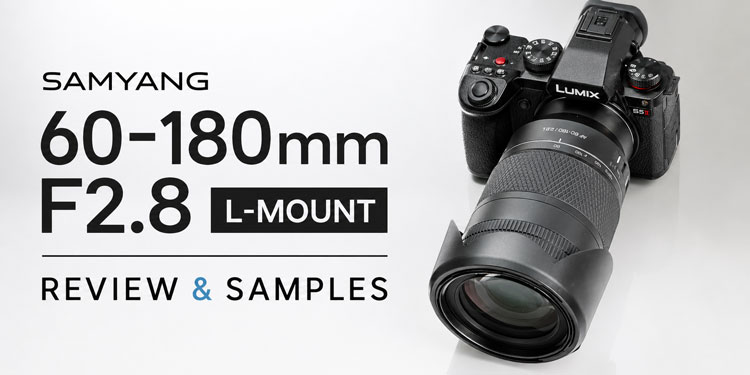
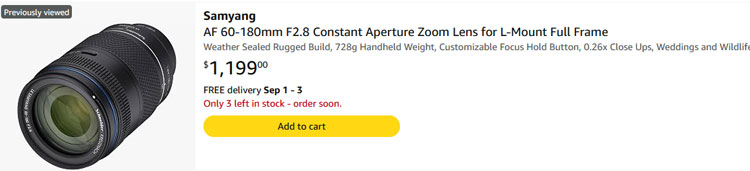
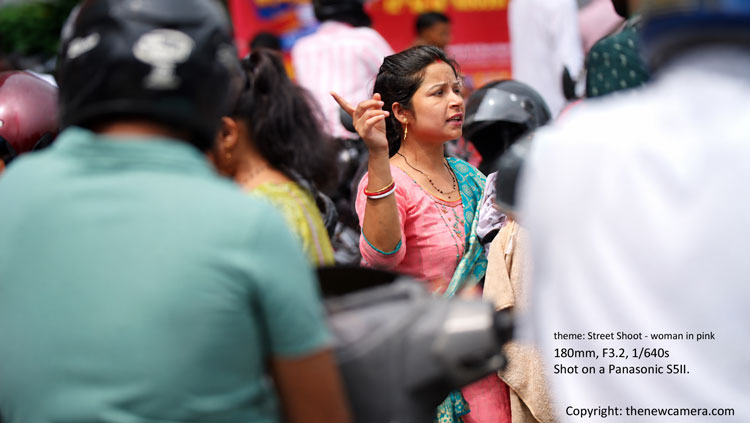
L-Mount shooters have been stuck with a bad choice: pay up and wear a 3-pound 70-200, or pretend a 28-70 can do telephoto work. Before Begin Let me clarify this is a non-sponsored post. LK Samyang’s new AF 60-180mm F2.8 L is the first lens that actually breaks that stalemate. It is a constant F2.8 zoom. It weighs 728g — 1.6 pounds. It sells for $1,199 in the U.S., $100 more than the Sony E-mount version and hundreds less than Sigma, Panasonic, or Leica’s 70-200s. No optical stabilization. The barrel extends when you zoom. And after one afternoon on a Panasonic S5II, it already made the frame that answers the only question most people have: can a cheap, light tele zoom isolate a face in a crowd at 180mm?
Yes. Look at this.

Caption: Samyang 16-180mm F2.8 – @180mm, F3.2, 1/640s on a Panasonic S5II. This is the sample image. Lens AF lock speed is amazingly fast while capturing faces during street shoot
Quick specs (so you can keep scrolling)
- Lens: LK Samyang / Schneider-Kreuznach AF 60-180mm F2.8
- Mount: L-Mount full frame (also Sony E)
- U.S. price: $1,199 L-Mount / $1,099 E-Mount (B&H)
- Weight: 728g L / 730g E — 1.6 lb
- Aperture: F2.8 constant, 9 blades
- Optics: 17 elements / 14 groups (7 ED, 2 aspherical, 1 HR)
- Min focus: 13.8 in / 0.35m at 60mm; 31 in / 0.79m at 180mm
- Max magnification: 0.26×
- Filter: 77mm
- OIS: none (use IBIS)
- Weather sealing: yes
- Camera for these samples: Panasonic Lumix S5II
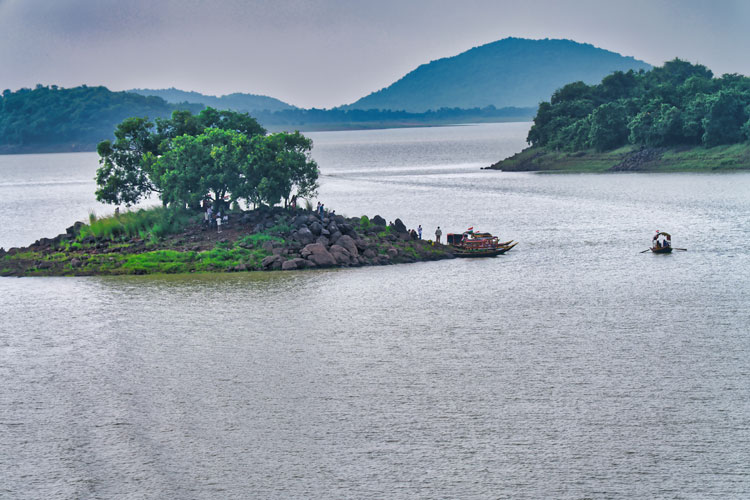
These are field samples, not lab charts. They were shot at Maithon, a reservoir in eastern India – think lake town, rental boats, haze, and a street that never empties. Flat light until evening. That is a better test than a brick wall in an air-conditioned studio.
What you’re actually buying
Everybody writes “70-200” on a press release. In the hand, the extra 10mm at the short end is the more useful number. Sixty millimeters is still an environmental lens. You can stand on a boat landing, keep a hull, a ramp, and three people in life jackets in the same frame, and not feel like you stepped into a longer prime. At the other end, 180mm is enough to pull a face out of traffic or a flag off a moving boat.
The spec sheet is honest about the compromises. Linear stepping motor. Floating focus. USB-C on the barrel for firmware. Weather seals at the moving parts. No OIS.
On an S5II that last point matters. The body has good in-body stabilization, but at 180mm you are still asking a sensor-shift system to tidy up a long, slightly front-heavy zoom. The street frame that opens this review was 1/640 at F3.2. That is not heroic. It is the correct way to use a lens that does not stabilize itself.
Sample images: sharpness, isolation, and that 180mm street shot
The woman in pink is the picture I would send anyone who asked what this lens does. She is not posed. She is mid-sentence, finger up, jewelry catching the only decent light on the block. The mint-green shirt and the white sleeve in the foreground are not mistakes. They are what 180mm does to a crowd: it turns other people into weather.
Look at the jewelry before you look at the bokeh. The chain, the earring, the red-and-white bangles – those edges are where a mid-priced zoom usually goes soft first when you shoot through heat and dust. Here they hold. The fabric of the blouse keeps its grid. The teal border of the scarf does not smear into the pink.
This frame is F3.2, a third of a stop down from wide open, and the subject is not at minimum focus. That is how most people will actually use 180mm: a person, a little distance, a mess behind them.
Autofocus did the unglamorous job. The S5II’s subject detection had a face to lock, and the lens did not hunt in a way the file records. You cannot judge tracking from one still. You can only say the still is sharp where it needed to be sharp.

Caption: Mother Love. 180mm, F3.2, 1/640s, Panasonic S5II.
Sample images: color on a gray lake
Flat light is a mean test for color. Everything wants to go olive. The two tourist boats — “Babu Boat,” Ghat 3 and Ghat 8, “I Love Maithon” painted on the seats like a joke that became a brand – are useful because they are loud on purpose. Green hull, red bench, yellow stern, sunflower decals.
The lens does not hype them. That is a compliment. Oversaturated greens are the usual sin of contrasty telephotos on overcast water. They turn grass fluorescent and leave the hulls looking like toys. Here the paint stays in the world. You can read the lettering without leaning in.
If you are shopping this zoom as a cheaper 70-200, this is the file that answers the sharpness-at-normal-distance question better than the street shot. Nothing is moving. The subject is a set of straight lines and hard colors. They survive.
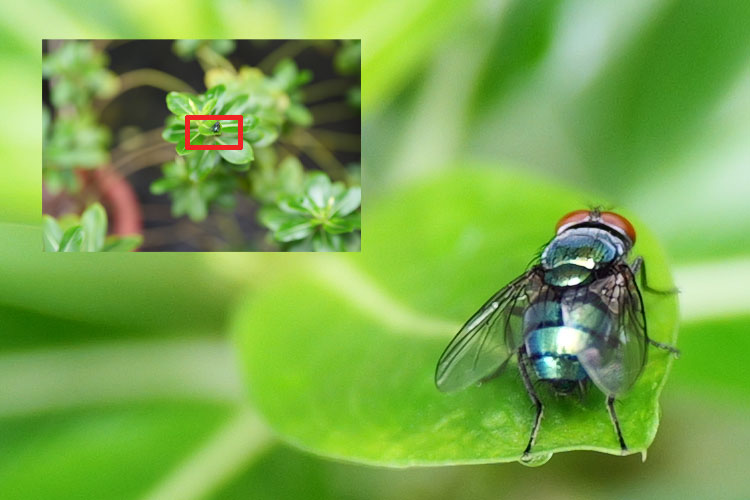
Captred Housefly on a Leaf, @60mm F2.8 S5 II, Scaled at 100%

Caption: Mid-range color test. If the lettering goes, the lens has already told you what it is.
Sample images: telephoto compression

The small rocky spit in the reservoir is the most “this is why you buy a zoom” picture in the set. A wide lens would have made a postcard: water, a lump of land, some sky. At the long end of 60-180 the trees sit on the rocks, the people become a scale marker, the moored boat tucks into the shore, a second boat crawls away, and the hills behind them step forward.
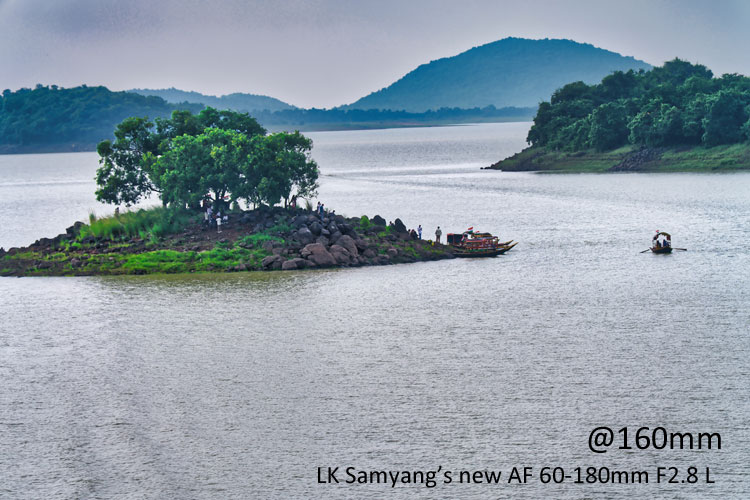
That stacking is what you pay for. Not bokeh. Not the word professional. The ability to make distance feel arranged.
The haze is honest – humid-country air, not a mist filter. The far ridge goes blue-gray the way it should. Contrast falls off with distance instead of being punched back by in-camera Clarity. If you like crunchy landscapes, add that later. The file does not force the decision.
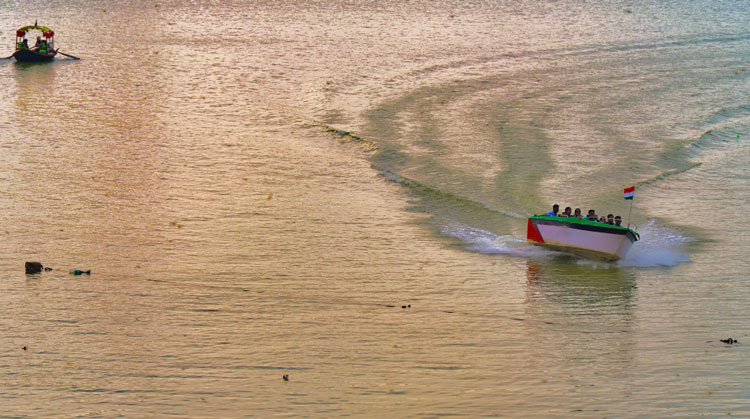
One frame has to move, or this is only a review of parked things. The speedboat with the Indian flag is that frame: orange and green hull, Yamaha on the transom, seven people, a white wake that has not yet decided to be elegant. The lens kept the boat together. Faces in the seats are small, but they are faces, not smudges. The flag is a sharp rectangle, which is harder than it looks when the thing is fluttering.
This is not a sports-AF test. It is one still, not a burst. What it shows is that an S5II and this zoom can freeze a rental boat at lake speed without the file feeling nervous. If you shoot football or birds, you will want a longer test. If you shoot the kind of life that happens on water — hired boats, flags, someone standing up when they should not — this is already relevant.
This is 60-180mm used as a notebook, not a portrait lens. You need enough reach to stand on the bank and not become part of the boarding. You need enough width that the ramp, the boat, and the people still belong to each other. You need the colors of cheap steel and rental life jackets to stay ugly in the correct way. The file does that.
Then the weather finally did something. Cloud opened enough for a strip of sun to lay itself on the water. A small boat sat in the glitter like a period. The dock became a silhouette. Two figures on the rocks were doing the only sensible thing, which was looking at the light.
Tele zooms are often poor at this hour. They crush the sky into plastic or leave the land as a black step. This frame keeps both. The highlight on the water has a shape. The far trees are a line, not a smudge. The little boat is dark enough to read as a boat.
Dynamic range here is more camera than lens — the S5II’s sensor is doing the heavy lifting — but a bad optic would have already veined the bright water with purple or washed the midtones. It does not.
What these pictures cannot tell you
It would be dishonest to turn a handful of frames into a full optical scorecard. There is no brick wall. There is no focus-shift test at F2.8 through the zoom. There is no video AF pull. There is no rain, even though the barrel is sealed. There is no night street with point lights to judge coma. Some E-mount reviewers have already called the zoom ring stiff; these files do not speak to that. They were made by someone who had already decided to take pictures instead of taking notes.
What they do say, with some confidence:
- At 180mm, subject isolation in a crowd is the real feature, not a marketing line.
- Color holds on loud, painted subjects without going sour in haze.
- The long end compresses a landscape the way you hope a 70-200 will.
- AF on the S5II is trustworthy on people and on a boat that is not trying to escape.
- You will want shutter speed at the long end. This lens will not save a 1/80 handheld hero shot.
Samyang 60-180mm F2.8 vs Sigma 70-200 (and the rest) L-Mount does not get a Tamron 70-180. The comparison that actually matters is Sigma’s 70-200mm F2.8 DG DN OS Sports, with the Panasonic and Leica 70-200s in the next chair.
Those lenses internally zoom, have optical stabilization, and feel like tools you throw in a wet bag. They also weigh about 2.9 to 3.7 pounds. The Samyang is half that weight class. You feel it at the end of a staircase.
What you give up is not mysterious:
- No OIS, so video walk-and-talks and dusk handheld work depend on the body
- Extending barrel, so more moving surface area than an internal-zoom design
- 180mm, not 200mm
In stills at Maithon, none of those absences showed up as a missing photograph. They will show up if your work is indoor ceremony aisles at 1/100, or if you live on a monopod at a football game.
Against primes, the math is simpler. An 85mm and a 135mm will usually be sharper and prettier wide open. They will not give you the spit of land, the speedboat, and the dock without walking a mile and missing the light. This zoom is a coverage argument, not a bokeh argument.
Who should buy the Samyang 60-180mm F2.8 L
Buy it if:
- You shoot Panasonic S5II / S9, Leica SL, or Sigma L-Mount bodies
- You want F2.8 reach without wearing a 70-200
- You travel, shoot people, or work events where weight is the real enemy
- $1,199 is the number that makes the lens leave the store
Skip it if:
- You already own the Sigma 70-200 Sports
- You need built-in stabilization for video or slow shutter work
- You need internal zoom and 200mm for sports
- You want a lab-perfect optic more than a lens you will actually carry
Field scorecard
Treat these as notes from one afternoon, not laboratory marks.
- Handling / weight: 9 — this is the reason to buy it
- Isolation at 180mm: 9 — the street file is the evidence
- Color: 8 — natural in haze, no neon grass
- Landscape compression: 9 — exactly what a short tele zoom is for
- AF with S5II stills: 8 — trustworthy on people and a hired boat
- Stabilization: 4 — none in the lens; plan shutter speeds
- Value on L-Mount: 9 — the best part of the product
Verdict
The LK Samyang AF 60-180mm F2.8 is not the best F2.8 tele zoom you can put on an L-Mount body. It is the one you will actually take to a lake on a gray day, and then into a street where nobody is waiting for you to change lenses.
The Maithon files are modest pictures. That is why they are useful. They show a lens that keeps faces, paint, distance, and a little weather in the same afternoon without asking to be treated like laboratory equipment.
On the S5II, at 180mm, in a crowd, it already made the photograph I would keep. The rest of the set is the walk back to the car. For a 1.6-pound zoom at $1,199, that is a decent day’s work.
The article “Don’t Buy a 3-Pound L-Mount 70-200 Until You See These Samyang 60-180mm F2.8 Samples” was written by thenewcamera.com team on 4:22 pm, Thursday, 27 August 2026, Greenwich Mean Time (GMT). | You can also follow us on Our Official Social Media Handles FACEBOOK | TWITTER | INSTAGRAM > get live news — > DJI Rumors | Insta360 News
By admin, on August 25th, 2026
So it’s time for a new drone; possibly Insta360 is preparing for a compact drone announcement to give us a perfect alternative to NEO 2?, As we all know, due to recent events, possibly sarting from September to the 1st half of 2027, the United States of America will wipe out all available LiDAR-based drones from the market, which also includes the recently announced DJI Neo 2. We have already posted a detailed article on the list of drones that are about to be banned very soon after this September.
UPDATED CONTENT: AUG 26 2026
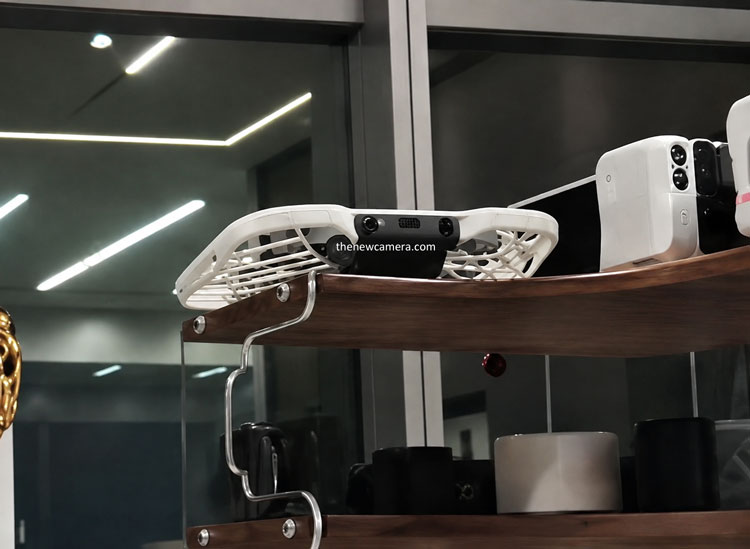
The image seen above was shared by Liu (insta 360 CEO) . And the image did not originate as a fresh Reddit retail shot. Igor Bogdanov posted the same office on 31 May 2026. It is Liu Jingkang’s official desk. That confirms the location. It does not, by itself, confirm the white lattice-cage unit is an Insta360 NEO Style prototype. Liu has previously kept competitor drones on his desk as references, and this cage geometry still matches HoverAir more closely than Insta360’s published compact-drone patents. We are treating the Insta360 identification as Igor’s working theory, not as a confirmed product.
Here is a catch: recently, a new image surfaced on the web from Reddit. A post titled “Current state of 360 and action cameras” with a description in the image: “Insta360 next drone, foldable under 250g have ” and are now circulating widely. The images show a white compact flying camera with a continuous lattice protective cage sitting on a retail shelf next to dual-lens 360 cameras. While the unit has sparked speculation that it could be linked to Insta360’s rumoured second drone, a closer look at the evidence is required.
The Photos Raise Questions, Not Confirmation
The clearest versions of the images reveal a white continuous lattice-style cage wrapping around a black central camera module.
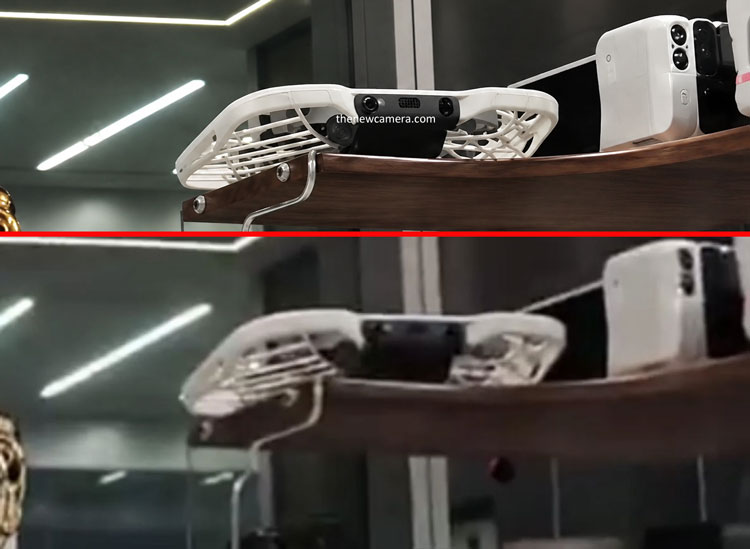
By clearing up the image, we are able to notice two different sets of camera modules.
The form factor is low and wide when the cage is open. It is placed directly beside white dual-lens 360 cameras, which has fueled the Insta360 connection in community discussions.
However, this continuous full-cage design currently matches the already-released HoverAir X1 more closely than any publicly available Insta360 prototype imagery.
What We Actually Know About Insta360’s Second Drone
Insta360 is developing more than one flying camera platform:
- The Antigravity A1 (launched under the incubated Antigravity brand) focuses on 8K 360 immersive capture with dual top-and-bottom lenses.
- A separate compact Neo-style project has been in development since at least mid-2025.
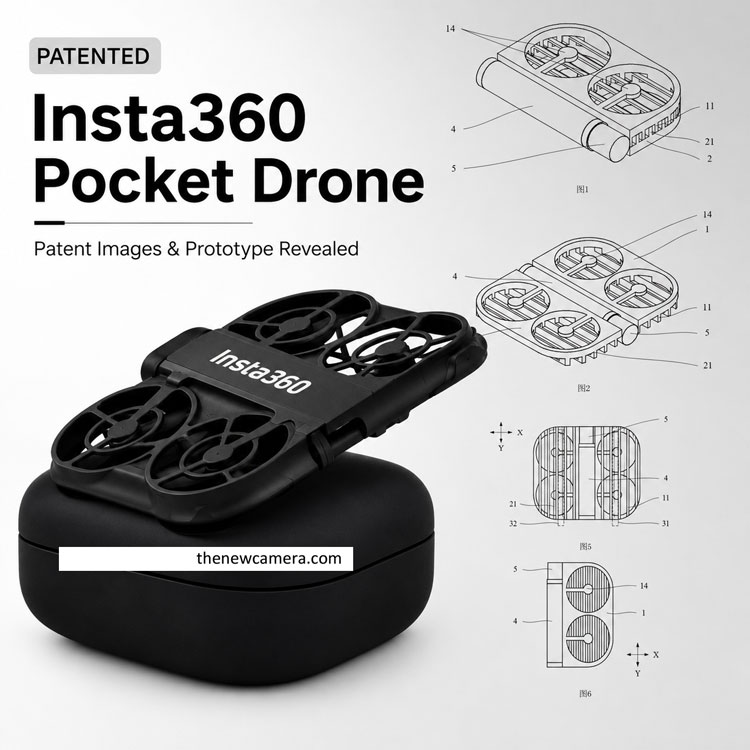
In July 2026 we covered Chinese utility model CN223865117U. That patent describes a highly foldable sub-250g drone with arms that fully retract into the body and individual ring-shaped propeller guards. Early prototype photos from August 2025 (first reported on thenewcamera.com) showed black units with ring guards being tested alongside Antigravity development mules.
None of the confirmed patent drawings or 2025 prototype images shows the continuous white lattice cage visible in the new photos.
Sub-250 g is a big market, specifically in the USA
DJI has created a very large market in the United States of America, specifically in the sub-250 g drone category, and now it has been left empty. No updates are coming. DJI has been banned, and the roles will become vacant and will get swiped out of the market.
This is really a very huge opportunity for any drone maker. Those who can increase the number of options available to consumers and make an attractive drone will finally have a new series.
Strategic Context
Btw, the good news is Insta360 already dominates consumer 360 cameras. These images are interesting and worth watching, but they do not yet constitute confirmed evidence of an Insta360 prototype.
The continuous cage design aligns more strongly with existing products on the market. Until higher-resolution images, official confirmation, or updated patent filings appear, the safer reading is that this remains speculative.
We will continue monitoring for clearer photos, additional patent activity, and any official statements. The compact Neo-class segment is heating up, and Insta360’s next move in this space will be significant whenever it arrives.
Stay tuned for updates.
Source updated: Igor Bogdanov, 31 May 2026, Liu Jingkang’s office — not a new Reddit retail shot.
The article “Insta360 Compact Drone Rumours Heat Up: New Cage-Style Images Surface” was written by thenewcamera.com team on 7:50 pm, Tuesday, 25 August 2026, Greenwich Mean Time (GMT). | You can also follow us on Our Official Social Media Handles FACEBOOK | TWITTER | INSTAGRAM > get live news — > DJI Rumors | Insta360 News
Insta360 True DJI Neo 2 Competitor Emerges: Foldable Drone Prototype Patent Details Surface
|
KEEP THIS BLOG ALIVE - Support New Camera Buy Canon Lenses, Buy Music CD or Digital Camera at amazon it helps this site, and you do not pay anything extra, it is just a way to help support this site.

|